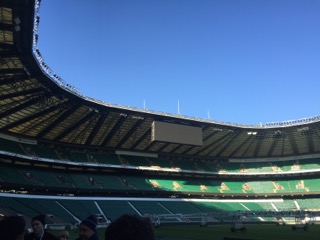
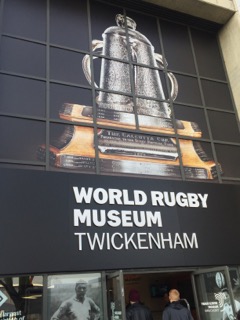
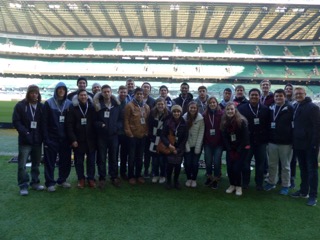
Today we all made the trek to Twickenham Stadium, the national rugby stadium of England. My flat and I took the tube to London’s Waterloo Station, and then took a train to Twickenham, a small town in western London. After arriving at the station there we made the 10 minute walk to the stadium, and met up with the group. The day started off with a tour of the World Rugby Museum. We spent a half an hour walking around getting a small taste of the tremendous history of rugby in England and across the world. There were endless jerseys, pictures, and all of the trophies that are played for in the rugby world. One of the biggest, and most important trophies they had there was the Calcutta Cup. It is the trophy awarded to the winner of the England-Scotland game that is played annually. England is currently winning the overall rivalry, 69-39-14. After we toured through the museum, we listened to a speaker who gave a talk on the history of rugby. We received a brief explanation of how rugby came to be. Our tour guide then took us on the full tour of Twickenham Stadium. We got a first hand look at the luxury boxes, the Royal Box, the Council Room, the dressing rooms, and we got to go pitch side to check out the stadium from a different perspective. Overall it was a great day and we all left more knowledgable about the game of rugby. Now I am going to turn to a Q&A with flat 80 to learn more about what we learned and saw today:
Q: How do you think the tradition of rugby has changed since the introduction of professionalism?
A (Dane Birkeland): I feel that the advent of professionalism has had a positive impact on the game, on balance. The amateur spirt of the game still exists with the respect between the players and the drinking traditional that filter down through the players into the attending fans. The professionalism just adds extra money into the game which helps with player careers, stadium improvements, and more research into player health. Now more player can make careers of rugby and the sport has increased as a competitive atmosphere, which is goos for the players and fans alike. So on balance, the acceptance of professionalism has benefited the game in many more ways than it has damaged its traditions and values.
Q: How has the game and the history of rugby been affected by the split of the Rugby Union and the Rugby League?
A (Ian Doherty): While I cannot be certain I think the split of rugby has had negative consequences for the sport as a whole. Obviously, people still follow and care about rugby but I think the following could be much stronger if there was just one professional league. With just one league the competition would be much stronger and it would bring together all of the fans from both leagues. I’m not sure if rugby could compete with soccer but I think it could have been more popular not only in the UK but across the world had the Union and League chosen not to split and rather competed against one another.
Q: Compare Twickenham to the other football stadiums that we have toured or watched a game in.
A (Tyler Rolland): Comparing Twickenham to the football stadiums that we have attended, it is very clear that the Twickenham Stadium has a much larger capacity. With the capacity of 82,500 people which can attend any given game, it’s size is very evident approaching and sitting inside the stadium. Twickenham also has a lot more pubs on it’s grounds. The sale of beer is prohibited during the play of football games and drinks aren’t allowed in the stands which means less pubs and concessions at the football stadiums. Rugby games do not have this restriction, therefore the spectators at the rugby games can drink quite a large amount. The last main difference between Twickenham and the average football stadium is the lack of security/police. During a football game the stands are overwhelmed with security guards separating the opposing fans and the home crowd, at a rugby game there are zero security inside of the Twickenham Stadium.